


|
Purpose |
Run the User Group Report to identify users who logged in during a selected date span and review the user groups, account status, provider, and login information recorded for those users. |
|
Who should do this |
CAREWare administrators, security or privacy staff, data managers, and designated support staff with access to Administrative Reports. |
|
Use this setup when |
Reviewing user access history, confirming group membership during an audit period, or checking activity for active and retired accounts. |
|
Main warning |
The report includes users who logged in during the selected period. Provider and status filters can exclude records, and the group shown reflects the user group recorded at the time of login. |
|
Video walkthrough |
Quick path
|
Reports > Administrative Reports > User Group Report |
Before you begin
• Log into Central Administration when the report must include more than one provider.
• Define the date span and the provider domains that must be reviewed.
• Decide whether the report should include all users or be limited to Active or Retired accounts.
• Review Manage User Groups when group names, permissions, or current assignments need confirmation.
|
Important The User Group Report is an administrative audit report, not a custom report definition. |
Open the User Group Report
Step 1. Click Reports.
Step 2. Click Administrative Reports.
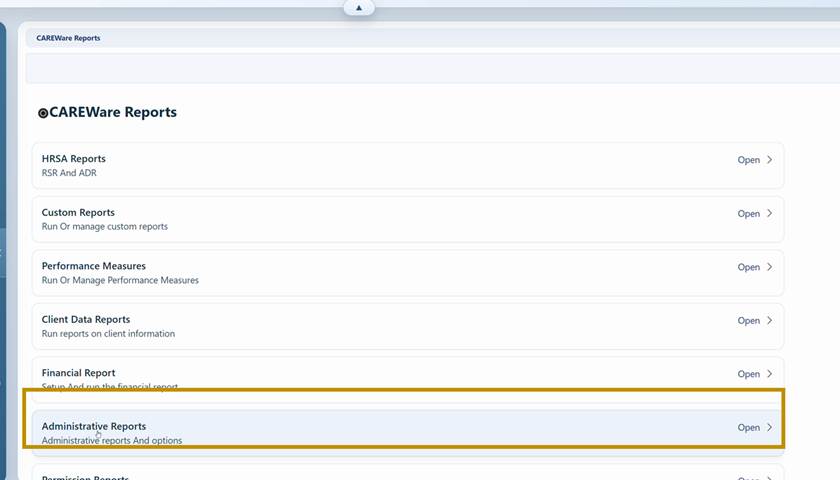
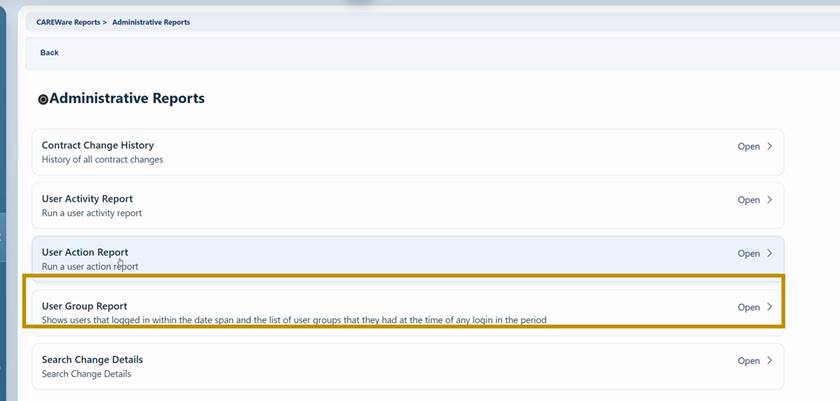
Step 3. Click User Group Report.
Select the provider scope
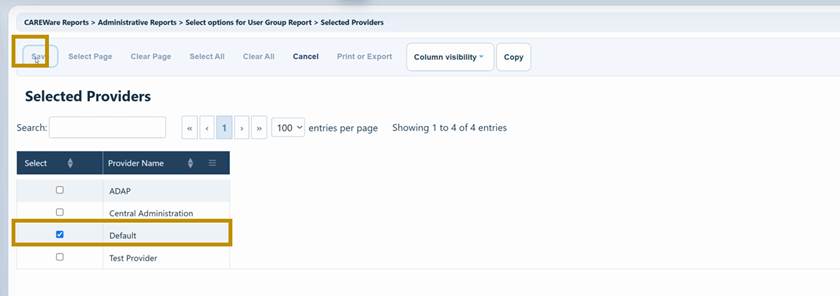
Step 4. In Central Administration, click Provider Filter.
Step 5. Select each provider that should be included. Use Select Page or Select All when appropriate.
Step 6. Click Save.
|
Important The provider filter controls which provider domains are searched. Confirm the selected providers before running or exporting the report. |
Set the date span
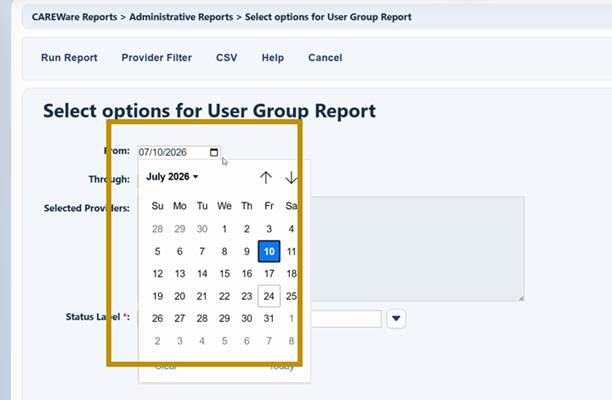
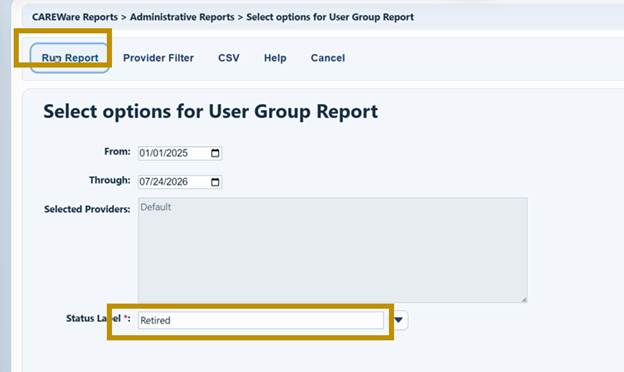
Step 7. Set the From date.
Step 8. Set the Through date.
Set the status and run the report
Step 9. Select Active or Retired in Status Label when the results should be limited. Leave the filter unset to review both statuses.
Step 10. Click Run Report.
Review the results
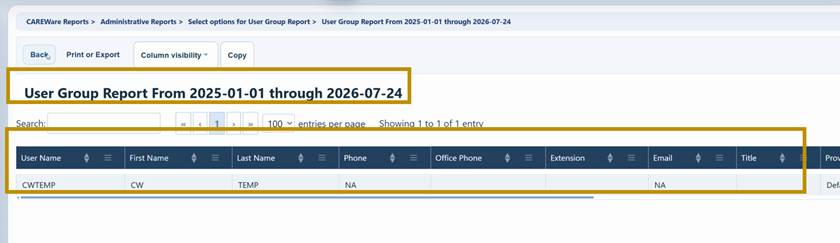
Step 11. Confirm that the report title shows the intended From and Through dates.
Step 12. Use Search, entries per page, and Column visibility to review the grid.
Step 13. Scroll horizontally as needed to review provider, user group, status, and last-login information.
Step 14. Click Print or Export for a formatted output, or return to the options screen and click CSV for spreadsheet data.
|
Important ACT identifies an active user account. RTD identifies a retired user account. A retired user remains in historical records so prior activity can still be audited. |
User Group Report options
|
Option |
What it does |
When to use it |
|
Provider Filter |
Selects the provider domains included when the report is run from Central Administration. |
Use to limit the review to the providers in scope. |
|
From / Through |
Limits results to users who logged in during the selected date span. |
Use the audit, review, or investigation period. |
|
Status Label |
Limits the report to Active or Retired users. |
Use when reviewing current accounts or retired-account history. |
|
Run Report |
Opens the report results in the browser grid. |
Use for interactive review and validation. |
|
CSV |
Exports the report results as a downloadable CSV file. |
Use for sorting, reconciliation, or controlled audit documentation. |
|
Search |
Filters the displayed result rows by matching values. |
Use to locate a user, provider, group, or status after the report runs. |
|
Column visibility |
Shows or hides result columns. |
Use to simplify the grid without changing the report data. |
|
Print or Export |
Opens output options for the result grid. |
Use for a formatted review copy or approved distribution. |
How to interpret the main result fields
|
Field group |
What it shows |
Review guidance |
|
User identity |
User name, first and last name, phone, email, title, and other user-account details. |
Confirm that the row belongs to the intended CAREWare account. |
|
Provider |
The provider associated with the reported login and user-group record. |
Confirm the provider is within the selected scope. |
|
User group |
The user group recorded for the user at the time of login. |
Compare with current setup only after accounting for later group changes. |
|
Status |
ACT for active accounts or RTD for retired accounts. |
Use the status filter to isolate one account state when needed. |
|
Last login |
The most recent login information represented in the report period. |
Use with the date span to identify recent or historical account use. |
How to confirm it worked
• The report title displays the intended From and Through dates.
• The providers represented in the grid match the selected provider scope.
• The account statuses match the Status Label filter.
• A known user who logged in during the period appears with the expected provider and group history.
• The exported CSV or formatted output contains the same reviewed rows and date span.
Helpful security and report-review tips
• Start with a short date span and a known user before running a broad audit.
• Use Manage User Groups to verify current group assignments; the User Group Report reflects group history at login.
• Use User Activity Report to review login and activity volume by user and provider.
• Use User Action Report when the review must identify exact actions such as running a report or editing data.
• For custom reports, review User Group Admin (Reports) separately. General user-group permissions and report-field restrictions are different controls.
• Export only the minimum user information needed and store the file in an approved secure location.
|
Warning Do not share CAREWare accounts. Audit history is tied to the username that performed the activity, so shared accounts make access reviews and investigations unreliable. |
|
Tip When an unexpected group appears, compare the report date with the dates of user-group changes. A difference from the current assignment may be correct if the user logged in before the assignment changed. |
Troubleshooting and common questions
Why does the report return no records?
Confirm the From and Through dates, select the correct provider domains, remove the Status Label filter, and verify that the user logged in during the period.
Why is a known user missing?
The login may fall outside the date span, the provider may not be selected, or the selected status may exclude the account.
Why does the user group differ from the current assignment?
The report shows group information recorded at the time of login. Review current assignments in Manage User Groups and compare the timing of later changes.
Why does a user appear with RTD status?
RTD means the account is retired. See Manage Retired Users for account-retirement guidance.
Why can’t a user open the User Group Report?
Review the account and report permissions in Provider User Manager or Manage Users.
Related CAREWare guides and resources
|
Resource |
How it helps |
|
Create groups, grant permissions, assign providers, and assign users. |
|
|
Manage user accounts, provider access, permissions, and report-field restrictions. |
|
|
Review provider-specific user access, permissions, groups, and account settings. |
|
|
Retire accounts while retaining historical activity for audit purposes. |
|
|
Review login sessions and activity counts by user and provider. |
|
|
Identify detailed actions performed by users, including report activity and data changes. |
|
|
Configure field-level restrictions for data displayed or exported through custom reports. |


