


|
Purpose |
Generate the RSR client-level XML file for HRSA submission and CAREWare review. |
|
Who should do this |
CAREWare users responsible for annual RSR data preparation and submission. |
|
Use this guide when |
You need to create, filter, review, or save the RSR Client Report. |
|
Main warning |
Use the correct reporting year and provider. Resolve RSR data-quality issues before final submission. |
|
Video walkthrough |
Quick path
|
Reports > HRSA Reports > RSR Client Report > Edit > select Year > Save > Run > Download RSR file |
Before you begin
• Confirm the current CAREWare build meets the RSR requirement for the reporting year.
• Confirm the user has the Run RSR permission and is working in the correct provider.
• Review RSR eligibility and service data before creating the final XML file.
|
Important For the 2025 RSR, report each eligible client who received at least one service the provider was funded to provide with RWHAP, RWHAP-related, or EHE initiative funding, regardless of payor. |
Create the RSR Client Report
Step 1. Click Reports.
Step 2. Click HRSA Reports.
Step 3. Click RSR Client Report.
Step 4. Click Edit.
Step 5. Select the reporting Year.
Step 6. Click Save.
Step 7. Click Run.
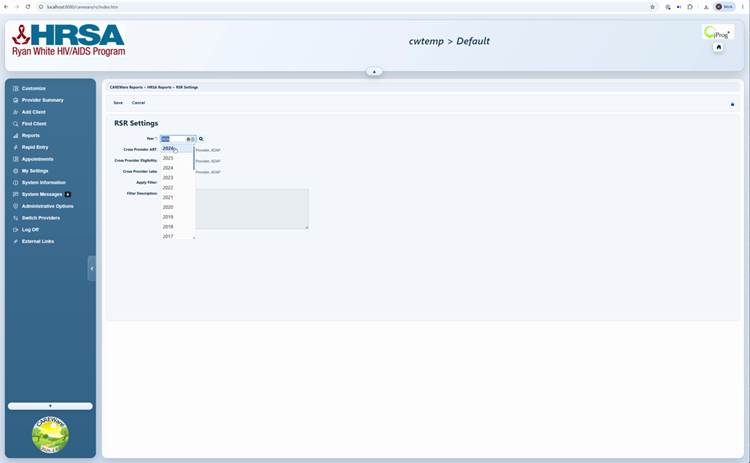
The image shows the reporting-year list in RSR Settings. Select the correct year before saving.
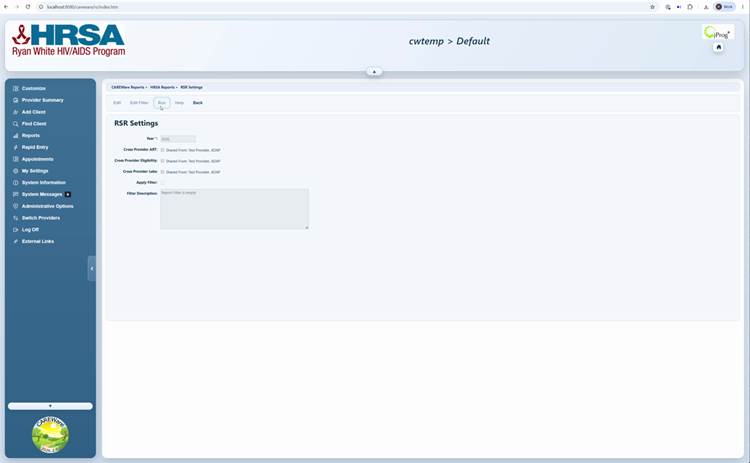
This image shows the Run action from RSR Settings.
|
Important If you run the report from Central Administration, select the provider when saving the settings before running the report. |
Save the completed XML file
Step 8. Wait for Report complete, then click Download RSR file.
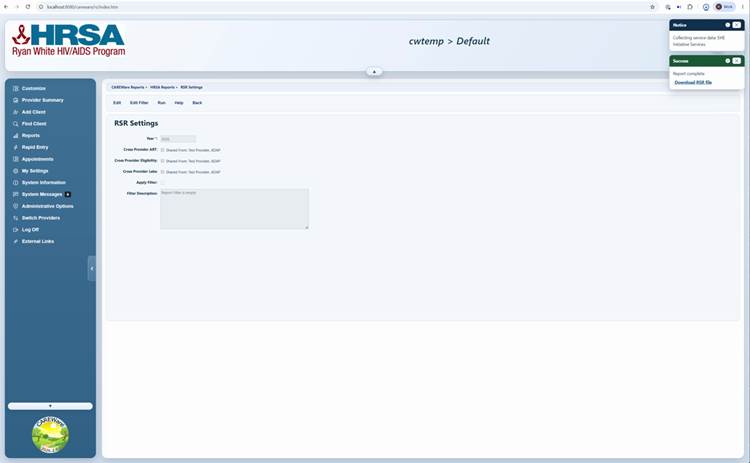
|
Tip Use the RSR Viewer to review client counts and the RSR Validation Report to identify alerts, warnings, and errors before uploading the final file to HRSA EHBs. |
Cross-provider data
When data sharing is configured, CAREWare can include shared data in the RSR. The provider sharing the data appears beside the applicable setting.
|
Setting |
What it includes |
|
Cross-Provider ART |
Shared ART medications for clients receiving OAHS services. |
|
Cross-Provider Eligibility |
Shared Ryan White eligibility used to determine RSR inclusion. |
|
Cross-Provider Labs |
Shared clinical results for clients receiving OAHS services, which may include CD4 Count, Viral Load, Pregnancy, and Syphilis. |
Filter results for review
Use a report filter to review selected client groups, such as age, race, funding source, or a custom field.
Step 1. Click Edit Filter.
Step 2. Click Add.
Step 3. Select a Field Name, then click Use Field.
Step 4. Complete Subfilter and Filter values as needed, then click Save.
Step 5. Click Back.
Step 6. Click Edit, check Apply Filter, then click Save.
Step 7. Click Run.
|
Tip The RSR Client Report uses the same filter options as a Demographics custom report. |
RSR data-quality checks
• Run the RSR Validation Report and correct errors; resolve warnings and alerts whenever possible.
• Use RSR Client Validation to review issues for an individual client throughout the year.
• Use Check Your XML to test schema compliance before submission. Files uploaded there are not submitted to HRSA.
• Review the Upload Completeness Report after uploading client-level data in the RSR Provider Report; HRSA requires it to be viewed before the Provider Report can be submitted.
|
Important For 2025, the UCI uses sex at birth. Missing sex-at-birth responses are not allowed, and “Unknown” is an available response option. |
Related CAREWare guides and resources
|
Resource |
How it helps |
|
Overview of CAREWare RSR guidance |
|
|
instructions for generating the client-level XML file. |
|
|
RSR alerts, warnings, errors, and affected clients. |
|
|
Review RSR issues for an individual client. |
|
|
Review RSR counts and client-level results. |
|
|
Current RSR manuals, data elements, and related documents. |
|
|
Review eligibility records that determine RSR inclusion. |
|
|
Instructions for upgrading CAREWare to the latest build. |
|
|
Instructions for managing provider and user permissions. |
|
|
Instructions for sharing data across providers. |
|
|
Login page for HRSA Electronic Handbook (EHB) |


